Unlocking Generative AI Amazon Bedrock : A Deep Dive into Real-World Use Cases.
Artificial Intelligence Tools for AI developmentPosted by tintin_2003 on 2025-12-27 18:44:20 | Last Updated by tintin_2003 on 2026-09-14 18:56:09
Share: Facebook | Twitter | Whatsapp | Linkedin Visits: 298
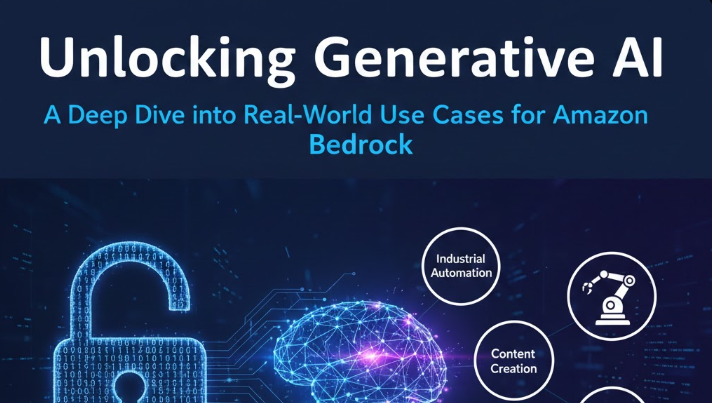
Introduction: The Generative AI Gold Rush and the "Serverless" Approach
Since the explosion of ChatGPT, every enterprise leader has been asking the same question: "How do we leverage Large Language Models (LLMs) safely, efficiently, and at scale?"
While the open-source community is vibrant, managing the infrastructure for massive models like Llama 2 or fine-tuning them is resource-intensive. Conversely, locking yourself into a single model provider via an API limits flexibility.
Enter Amazon Bedrock.
Amazon Bedrock is a fully managed service that offers a choice of high-performing foundation models (FMs) from leading AI companies like Anthropic, Cohere, Meta, Mistral AI, and Amazon Titan through a single API. It is essentially the "Switzerland" of AI platforms—neutral, secure, and incredibly versatile.
In this blog post, we will move beyond the buzzwords and explore the detailed, practical use cases of Amazon Bedrock across various industries, highlighting how it solves specific business challenges.
Why Amazon Bedrock? The Core Value Proposition
Before diving into use cases, it is crucial to understand why Bedrock is distinct. It is serverless. You do not need to manage GPUs or underlying infrastructure. You simply provision the throughput you need and pay for what you use.
Key features driving these use cases include:
- Foundation Model (FM) Agnostic: Swap models (e.g., from Titan to Anthropic’s Claude) with minimal code changes.
- Fine-Tuning: Train a model on your proprietary data without sharing it with the model provider.
- Agents: Automate multi-step tasks (e.g., API calls, database queries) based on natural language.
- Knowledge Bases: Give models context about your business (RAG - Retrieval Augmented Generation).
Detailed Use Cases by Industry
Let’s explore how organizations are deploying Amazon Bedrock today.
1. Financial Services: Risk Analysis & Compliance
Banks and fintech companies deal with massive volumes of unstructured text—contracts, earnings calls, and regulatory updates.
- Fraud Detection & Alerting: Instead of just flagging transactions based on heuristics, Bedrock can analyze the narrative behind transaction patterns to explain "why" a flag was raised, helping compliance officers make faster decisions.
- Contract Intelligence: Legal teams can upload thousands of PDF loan agreements. Using Knowledge Bases, Bedrock can instantly answer questions like, "What is the early repayment penalty for Client X's contract dated Jan 15th?"
- Sentiment Analysis on Earnings Calls: Analyzing audio-to-text transcripts of CEO calls to gauge executive sentiment and predict market movements with higher nuance than keyword matching.
2. Customer Experience & Retail: The Hyper-Personalized Agent
Retailers are moving away from rigid, flow-chart chatbots to fluid conversational AI.
- Context-Aware Shopping Assistants: A customer asks, "I need a durable backpack for hiking and city commuting." Using a model like Amazon Titan, the agent understands the semantic overlap of "durable" and "commuting" and suggests products based on detailed product descriptions.
- Intelligent Returns Processing: Instead of a simple form, Bedrock can analyze the customer's reason for return (e.g., "too small but liked the fabric") and suggest the exact next size or an alternative fabric type, reducing churn.
- Multilingual Marketing Content: Generating ad copy for a product in 10 different languages simultaneously, ensuring cultural nuance is respected by selecting the appropriate underlying model (e.g., using Cohere for strong multilingual capabilities).
3. Software Development: Accelerating the SDLC
Bedrock isn't just for customer-facing apps; it is a powerhouse for internal engineering teams.
- Code Explanation and Documentation: Developers can highlight a complex block of legacy code and ask Bedrock to explain it in plain English or generate DocStrings, drastically reducing technical debt.
- Unit Test Generation: You can feed a function into Bedrock and ask it to generate a comprehensive suite of unit tests (Python, Java, JavaScript) to ensure code coverage.
- SQL Query Generation (Text-to-SQL): Non-technical business analysts can ask natural language questions like, "Show me the top 5 customers by revenue in Q3," and Bedrock converts this into a valid, optimized SQL query to run against a data warehouse (e.g., Redshift).
4. Healthcare & Life Sciences: Operational Efficiency
Note: Healthcare use cases require strict adherence to HIPAA and data privacy. Bedrock’s serverless architecture ensures data is not used to train base models.
- Clinical Trial Summarization: Researchers deal with thousands of pages of trial results. Bedrock can summarize these findings into executive briefs, highlighting efficacy rates and adverse effects, allowing for faster go/no-go decisions.
- Patient Intake Automation: Processing unstructured doctor notes and filling out standardized electronic health record (EHR) forms automatically, reducing administrative burden on nurses.
5. EdTech: Adaptive Learning & Content Creation
- Interactive Tutoring (Socratic Method): Rather than giving direct answers, a Bedrock-powered tutor can guide students through math problems by offering hints and asking probing questions based on the student's specific error.
- Quiz Generation: Teachers can input a textbook chapter (PDF) and instantly generate a 20-question quiz with multiple choice and short answer formats, complete with an answer key.
Comparison Table: Choosing the Right Bedrock Feature
To implement these use cases effectively, you must choose the right architectural component. Here is a breakdown of the primary Bedrock capabilities and when to use them.
| Feature | Best For... | Key Benefit | Example Use Case |
|---|---|---|---|
| Base FM Inference | General tasks, creative writing, summarization, quick prototypes. | Access to top models (Claude, Llama, Titan) without hosting. | Drafting marketing emails or brainstorming product names. |
| Fine-Tuning | Specializing models on proprietary data (style, format, specific domain knowledge). | Improving model accuracy on specific tasks; data stays private. | Training a model on your specific customer support voice and tone. |
| Knowledge Bases (RAG) | Q&A systems requiring specific, up-to-date data (e.g., manuals, policies). | Grounds the model in facts, reducing hallucinations. | A support bot that answers questions based on your latest user manual. |
| Agents | Complex workflows requiring actions (API calls, DB writes). | Automating the execution of tasks, not just text generation. | "Book a flight to London for next Tuesday" (triggering a booking API). |
| Guardrails | Safety filters, PII redaction, blocking harmful content. | Ensures compliance and brand safety. | Preventing the AI from giving medical or financial advice. |
Technical Deep Dive: How to Architect a Bedrock Solution
While Bedrock is serverless, the architecture around it matters. A typical advanced workflow looks like this:
- Input: The user sends a prompt via an application (e.g., a React frontend).
- Orchestration (AWS Step Functions): The prompt is routed. Is this a query looking for a specific document? -> Route to Knowledge Base. Is this a request to book a meeting? -> Route to an Agent.
- Retrieval (RAG): If using a Knowledge Base, Bedrock queries Amazon OpenSearch Serverless (or Vector Engine) to find relevant chunks of data.
- Augmentation: The retrieved context is appended to the original prompt.
- Generation: The augmented prompt is sent to the selected Foundation Model (e.g., Anthropic Claude 3).
- Safety Check: The output passes through Amazon Bedrock Guardrails to filter sensitive data.
- Action: If an Agent is used, Bedrock generates a JSON payload to invoke a specific AWS Lambda function.
Real-World Example: Building an "Enterprise Expert" Chatbot
Let's visualize a use case for a large manufacturing company.
The Challenge: An employee needs to know the procurement policy for buying software over $5,000. The policy document is 50 pages long and updated quarterly.
The Bedrock Solution:
- Setup: The company uploads the PDF policy document to an S3 Bucket.
- Vectorization: They create a Knowledge Base in Bedrock connected to S3. Bedrock automatically chunks the text and converts it into vector embeddings stored in a Vector Database.
- The Query: The employee asks the chatbot: "What is the approval workflow for a $6,000 software license?"
- Execution:
- Bedrock searches the vector DB for "approval workflow" and "$6,000".
- It finds the relevant section: "Procurements between $5k-$10k require Director Approval."
- It sends the prompt + context to Amazon Titan.
- Result: The bot replies: "For a $6,000 software license, you must get approval from your Director. Please submit Form 4B via the portal."
Why this works: The LLM did not rely on its internal training data (which might be outdated). It used the company's specific, up-to-date document, citing the exact policy.
Challenges and Considerations
While Bedrock is powerful, there are considerations for implementation:
- Latency: LLMs can be slow. For high-traffic apps, you need to request Provisioned Throughput to reserve capacity.
- Cost Management: While cheaper than hosting your own GPUs, costs can scale linearly with usage. Implement caching (e.g., Amazon DAX or Redis) to avoid re-processing identical prompts.
- Hallucinations: Even the best models make things up. Using Knowledge Bases (RAG) is the #1 way to mitigate this by grounding answers in your data.
Conclusion: The Future is Composable
Amazon Bedrock represents a shift from "building models" to "composing intelligence."
Whether you are in healthcare summarizing patient data, in finance analyzing contracts, or in retail building the next generation of shopping assistants, Bedrock provides the building blocks (Literature, Code, Safety, and Action) to do so securely.
By leveraging the features outlined in the table above—specifically Fine-Tuning for style and Knowledge Bases for accuracy—organizations can deploy Generative AI that is not just smart, but trustworthy.
Ready to experiment? The best way to start is with the Amazon Bedrock console, where you can test different models side-by-side in a playground environment without writing a single line of code.
Search
Categories
- Coding (Programming & Scripting)
- Artificial Intelligence
- Data Structures and Algorithms
- Computer Networks
- Database Management Systems
- Operating Systems
- Software Engineering
- Cybersecurity
- Human-Computer Interaction
- Python Libraries
- Machine learning
- Data Analytics
- Systems Programming
- Cybersecurity & Reverse Engineering
- Automotive Systems
- Embedded Systems and IoT
- Compiler Designs and Principals
- Apps and Softwares
Recent Articles
- Uninformed Search Algorithms in AI
- Pandas Data Wrangling Cheat Sheet
- Complete Guide to Seaborn Data Visualization: From Theory to Practice
- Informed Search Algorithms in Artificial Intelligence
- Derivation of the Softmax Function
- Gradient descent — mathematical explanation & full derivation
- Understanding Standard Deviation and Outliers with Bank Transaction Example
- ETL Pipelines in Python Explained with Code and Examples